






















Source: Rippling
The 14 Best Employee Onboarding Software Options in Australia
In this article
So, you’ve found the perfect hire. Congratulations! All those weeks of filtering and interviewing have paid off, and now you have a new team member who can help you take your business to the next level. There’s just one more hurdle to get over before they can do that: employee onboarding.
HR onboarding presents its own set of challenges, including access inconsistency, information overload, slow platform adoption, and payroll issues. These hold-ups can leave your team with more headaches than they started with, and a rocky onboarding experience can leave a negative impression on your new hire.
However, the right HR onboarding software can make all the difference. The best employee onboarding software options come packed with game-changing onboarding features that will make your life a lot easier. They include automated workflows, document management tools, built-in compliance, advanced analytics, and more.
I’ve reviewed the leading employee onboarding software options in Australia and judged them on seven criteria:
System reliability, authentication infrastructure, and identity management capabilities
Employee journey and accessibility
AU compliance and data sovereignty
Automation and agentic capability
Integration and ecosystem depth
Onboarding capability
Commercial transparency and market credibility
A note on transparency: Our product is in this list. However, I reviewed Rippling against the same criteria as all competitors, and you can review my full spreadsheet of ratings here.
First, let’s look at an overview of the top solutions.
Rank | Platform | Best for | Choose this if |
1 | Rippling | Mid-enterprises that want cutting-edge automation tech and strong ecosystem integration | You want a single, centralised HR onboarding platform with extensive time-saving features |
2 | Employment Hero | SMBs that want strong compliance and payroll features | You want integrated features to make payroll 100% hassle-free |
3 | ELMO HR | Mid-market enterprises needing strong alignment with Fair Work regulations | You want AU-specific payroll software with strong compliance |
4 | ADP Workforce Now | Enterprise brands focused on strong payroll/compliance infrastructure plus ecosystem breadth | You want large-scale onboarding with advanced lifecycle automation |
5 | Paycom | Enterprise companies that want strong automation and payroll, but not AU-specific | You want integrated payroll sync and native ATS connectivity |
6 | Workday HCM | Large enterprise brands that want analytics, configurability, and broad HR platform depth | You want configurable onboarding forms and advanced analytics (not AU-specific) |
7 | BambooHR | Australian SMBs looking for easy-to-use HR software with a decent breadth of features | You want native document management and native mobile onboarding UX |
8 | Bob | Mid-market brands that want a modern, people-first employee experience | You want native preboarding, good mobile UX, and strong sentiment |
9 | Personio | Mid-market companies that want a general HR system and don’t need deep Australia-specific payroll compliance | You want solid onboarding basics and broad ecosystem support |
10 | Sage HR | SMBs looking for a simpler HR tool with onboarding basics | You want a lightweight HR platform with native portal onboarding and a moderate ecosystem |
11 | Enboarder | Mid-market companies that want a great onboarding journey design without payroll/compliance | You want configurable onboarding entry and strong preboarding engagement |
12 | Deputy | SMBs to mid-market companies that want easy scheduling and time tracking | You want native award interpretation and workforce-ops features with partial onboarding capabilities |
13 | Tanda HR | SMBs to mid-market businesses that want scheduling/attendance and award interpretation | You want workforce management roots |
14 | Kallidus | Mid-market businesses interested in configurable onboarding workflows and good ATS integration | You want decent configurability with lighter compliance and ecosystem |
A detailed view of the best HR onboarding software in Australia
I ranked the 14 best employee onboarding software in Australia based on seven key areas. Below, I’m going to take a deep dive into the top 10. I’ll cover each platform’s main strengths and limitations, and share feedback from real users.
1. Rippling
Rippling comes out on top for many reasons. It features impressive HR automation capabilities (customisable onboarding workflows), identity and IT provisioning features (one of the few onboarding platforms with native IT automation), and an extensive ecosystem (650+ integrations), all of which make end-to-end employee onboarding 10x faster.
However, it stands out for the convenience it offers. Rippling centralises onboarding across HR, IT, and even payroll within a single workflow. This means your team will spend less time managing onboarding and get faster, more accurate results.
![[Media Item 1] Rippling | The 14 Best HR Onboarding Software Platforms in AU](https://www.rippling.com/_next/image?url=https%3A%2F%2Fimages.ctfassets.net%2Fk0itp0ir7ty4%2F3MthTb87numHq5MjrauII7%2F8f3cc03e72ecb3124aef4a86e3f4778e%2FRippling_2.png&w=1920&q=75)
Why do companies choose Rippling?
Best-in-class automation and orchestration
Very strong integration capabilities with native ATS connectivity
Attractive new-hire experience with responsive native portal
“Centralised dashboard makes it easy for single sign-on, access management, HR and Payroll tools. Automation of employee onboarding and offboarding is time saving and reduces manual emails between different teams like HR, Payroll & IT.” —Rippling Capterra review
User-flagged challenges
TFN and super are inferred via payroll integrations, not automatic
Payroll transfer is export-based
Pricing is only available via a form submission
Is Rippling right for your business?
If you’re a mid-enterprise brand struggling with slow and disconnected employee onboarding across departments, then Rippling is your best option. Not only does it offer centralised and user-friendly onboarding workflows that eliminate the hassle of manual labour, but it also provides an extensive integration ecosystem so you can achieve any result you need.
Rippling is great for employees, too, with a strong, simple employee portal that makes self-service easy.
2. Employment Hero
Employment Hero has impressive features across the board, including configurable conditional workflows, e-signature support, and assistive AI, plus a broad ecosystem with dozens of integrations.
However, the main attraction is Employment Hero’s strong performance in regulatory compliance and payroll processing. The platform offers sovereign residency for simpler compliance and automated super contributions, as well as automatic population of payroll records.
Employment Hero’s automation and AI capabilities are decent, although they remain its weakest area. Many automations, like identity and IT provisioning, are integration-based.
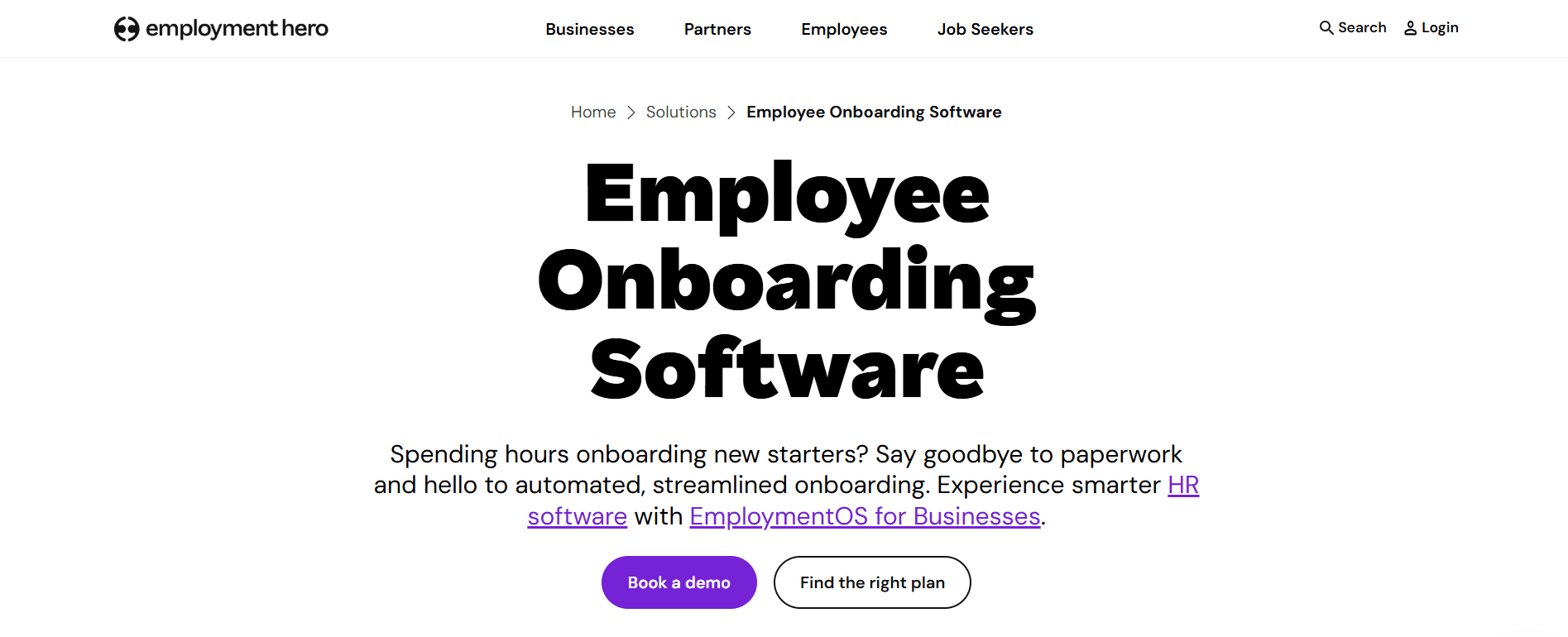
Source: Employment Hero
Why do companies choose Employment Hero?
Native TFN, native super workflow, native VEVO, and local payroll alignment
Well-rounded onboarding experience with portal
Dedicated AU support and high commercial transparency
“The platform is user-friendly and makes managing HR tasks much more efficient, from payroll to employee management. I especially appreciate the self-service features, which empower employees to manage their own information and requests. The compliance tools are another plus, helping us stay on top of regulations.” —Employment Hero Capterra review
User-flagged challenges
IT provisioning and identity are integration-based, not native
Analytics are basic rather than advanced
Workflow automation is solid, but not yet best-in-class
Is Employment Hero right for your business?
Employment Hero is a slightly smaller, though home-grown (Australian) employee onboarding software, which is both its advantage and its drawback. It’s great for Aussie SMBs that want solid overall onboarding features and especially need seamless payroll/compliance with minimal effort. However, its automation and agentic features aren’t as advanced as other solutions.
3. ELMO HR
ELMO HR (part of ELMO Software) ranks just below Employment Hero, even though many of its features match the latter’s. It ranks lower simply because its hiring cycle is slightly slower, although it’s still highly efficient.
Like Employment Hero, ELMO HR is second-to-none for Australia-specific payroll (through ELMO Payroll) and Fair Work compliance. It includes award interpretation and native VEVO automation, both of which make it easy to comply with Fair Work regulations.
ELMO offers a smaller bank of 12 integrations, which can make up for the lack of native automation capacity in many cases.
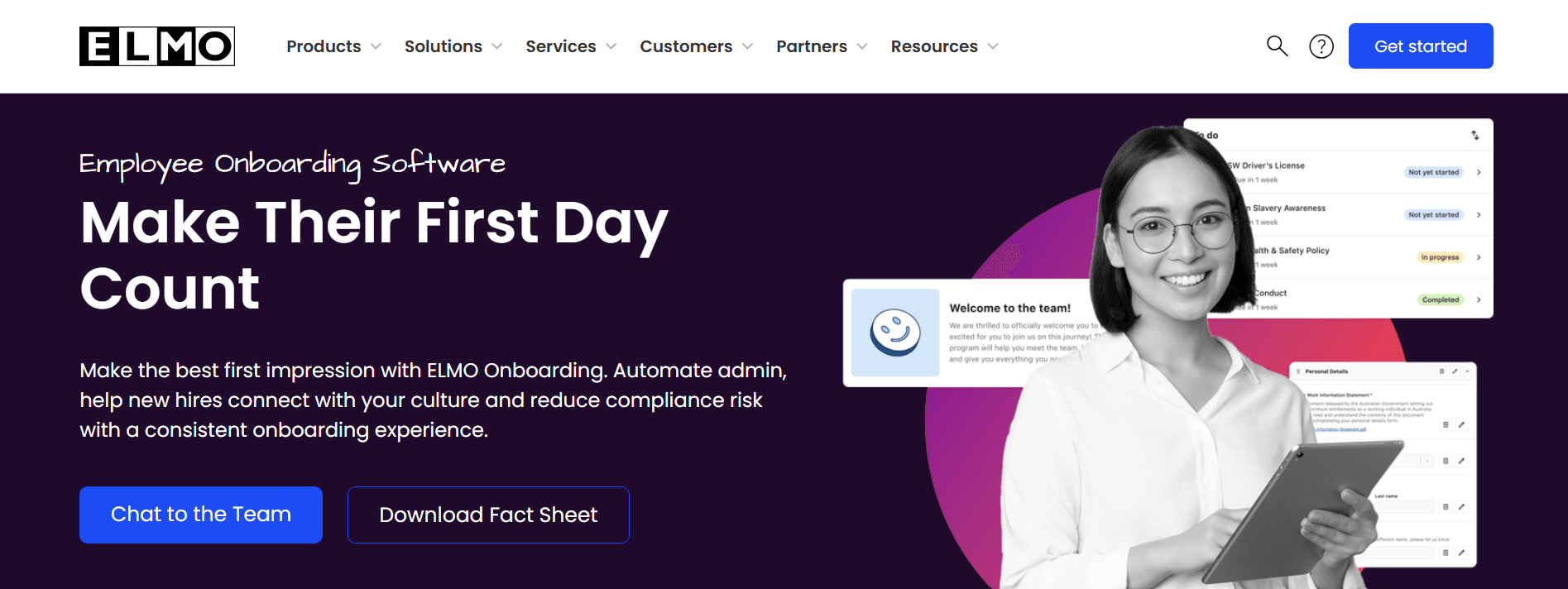
Source: ELMO HR
Why do companies choose ELMO HR?
Strong AU payroll and compliance alignment
Seamless combination of AU-focused HR and payroll
Good core onboarding experience with preboarding and mobile UX
“I primarily only use it as a end user, so from my point of view it is very simple UI easy to access information and manage my documents, I helped implementing it and the HR team loves it as it streamlined their operations immensely from the hiring process all the way through to their first day and beyond” —ELMO Software Capterra review
User-flagged challenges
IT provisioning and identity are integration-based, not native
Analytics and automation are good, but not particularly advanced
Its integrations ecosystem is smaller than competitors’
Is ELMO HR right for your business?
ELMO HR is a top pick for Australian mid-market enterprises that want leading payroll and compliance automation (native) and strong employee experience features. However, its integration ecosystem is notably small compared to Rippling’s and Employment Hero’s.
ELMO Software reviews on Capterra are 93% positive, showing a strong overall sentiment among users.
4. ADP Workforce Now
ADP Workforce Now is part of ADP, a global HR and payroll software giant. It’s one of the largest solutions on this list, which means it brings a ton of strong employee onboarding features, such as native portal onboarding, preboarding, document management, mobile UX, and super processing.
However, as a global option, ADP Workforce Now doesn’t offer as much Australia-specific data and compliance control as more local solutions. For example, it doesn’t offer full sovereign data residency (but rather regional hosting).
That said, it features a large integration ecosystem and mature workflow automation in many areas.
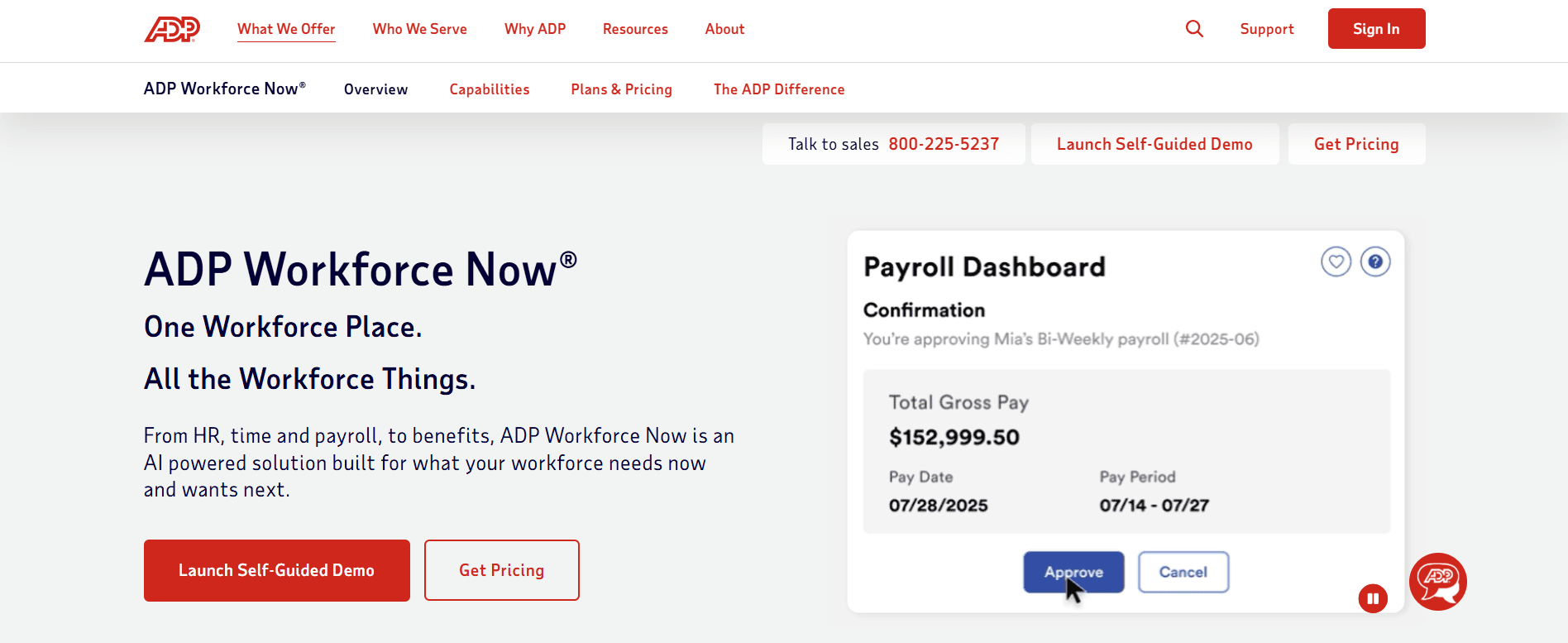
Source: ADP
Why do companies choose ADP Workforce Now?
Strong enterprise-grade workflow maturity with advanced automation
Deep payroll depth, including integrated payroll sync
Solid end-to-end onboarding fundamentals
“Extremely satisfied with this software. Saves lot of time and enables us to efficiently process our payroll and send to our management precise and very useful reports.” —ADP Workforce Now Capterra review
User-flagged challenges
TFN and super onboarding workflows are only inferred, not stated
Onboarding analytics are basic rather than advanced
Low pricing transparency may make procurement slower
5. Paycom
Paycom is a large library of connected HR and payroll solutions that cover everything from applicant tracking to time and attendance. Its onboarding solutions offer a wealth of employee onboarding capabilities for enterprise-level businesses, including configurable compliance workflows, automated super processing, advanced automations, and integration-based provisioning.
Paycom’s main drawback is its compliance and data sovereignty functions for Australian businesses. For example, it provides configurable VEVO compliance, although this isn’t native. Likewise, it offers regional hosting rather than full sovereign data residency.
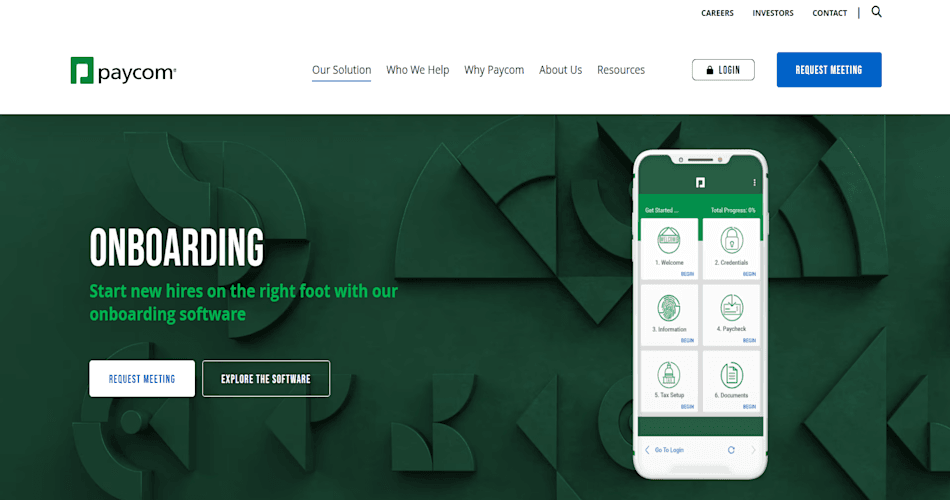
Source: Paycom
Source: Paycom
Why do companies choose Paycom?
Strong enterprise workflow automation and lifecycle orchestration
Good integrated payroll sync and ATS connectivity
Attractive overall onboarding UX with portal, preboarding, and mobile support
“The ease of processing payroll sometimes feels almost too simple and having a one stop shop for everything from payroll to recruiting to onboarding, provides a more seamless process in HR. Our associates also love the ability to navigate the tool on their phones through the Employee Self Service portal.” —Paycom Capterra review
User-flagged challenges
There is no documented TFN support for Australian onboarding
There is no documented native super capture
Compliance support is limited for Australia-specific use cases
6. Workday HCM
Workday HCM is another big-name employee onboarding software geared towards large enterprise organisations. Its combination of stellar employee journey features (native portal onboarding, preboarding, native document management, and mobile onboarding) and advanced onboarding analytics (including custom dashboards) makes it a standout for high-volume onboarding across departments.
There is one downside, however. Workday HCM scores relatively low in AU compliance and data sovereignty. This is largely because VEVO compliance, data sovereignty, and super contributions are all configurable/integration-dependent, not native.
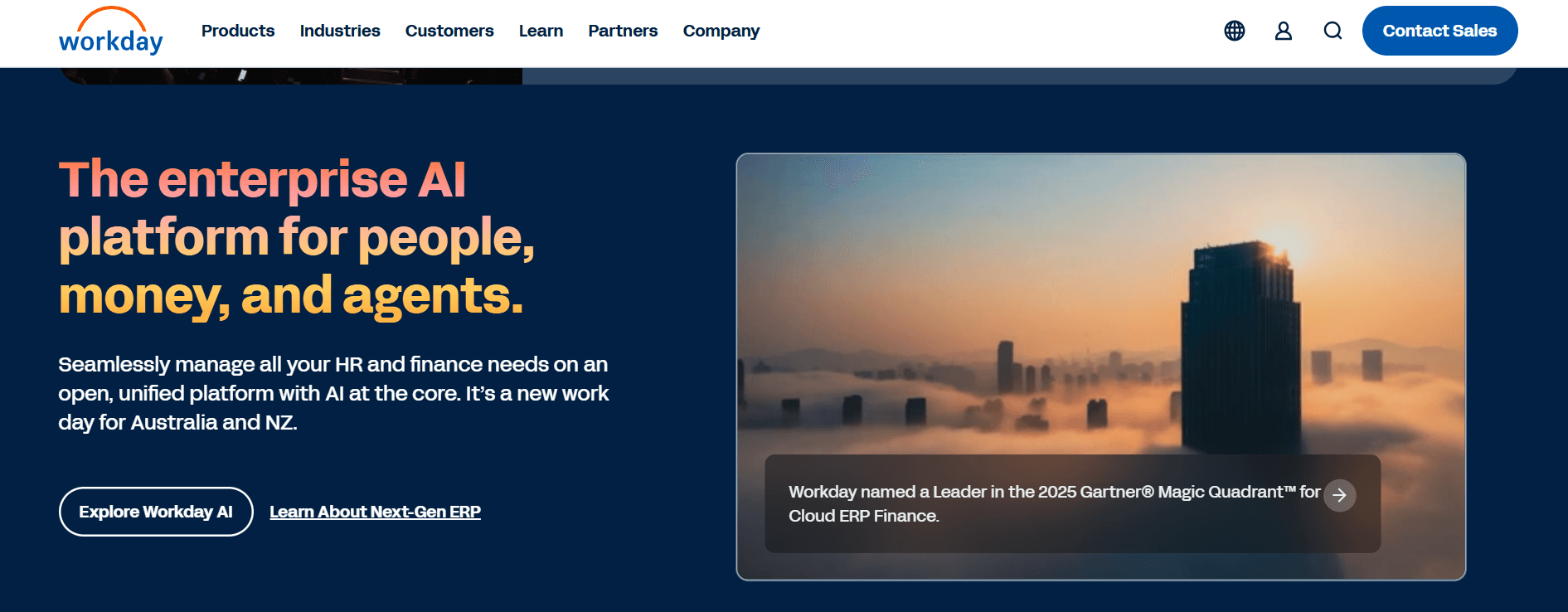
Source: Workday
Source: Workday
Why do companies choose Workday HCM?
Large enterprise platform depth with advanced automation and over 300 integrations
Strong integrated payroll sync and ATS
Solid functionality on a global scale
“Overall, Workday HCM is powerful and comprehensive, offering robust HR solutions, though it can be complex for newcomers.” —Workday HCM Capterra review
User-flagged challenges
AU-specific onboarding compliance is weaker
VEVO is configurable rather than native
Pricing transparency is low
7. BambooHR
BambooHR has one of the highest user sentiment scores among all the employee onboarding software solutions I’ve reviewed. This is partly because BambooHR is a smaller employee onboarding platform aimed at SMBs, so many of its features are more lightweight and easier to pick up.
BambooHR offers an array of top-tier employee experience features, configurable workflows, basic analytics, and integration-based provisioning. One standout is the advanced award rule automation, which many more expensive competitors don’t have.
Offsetting that, however, is the manual visa verification needed, plus the regional hosting (rather than full sovereign residency).
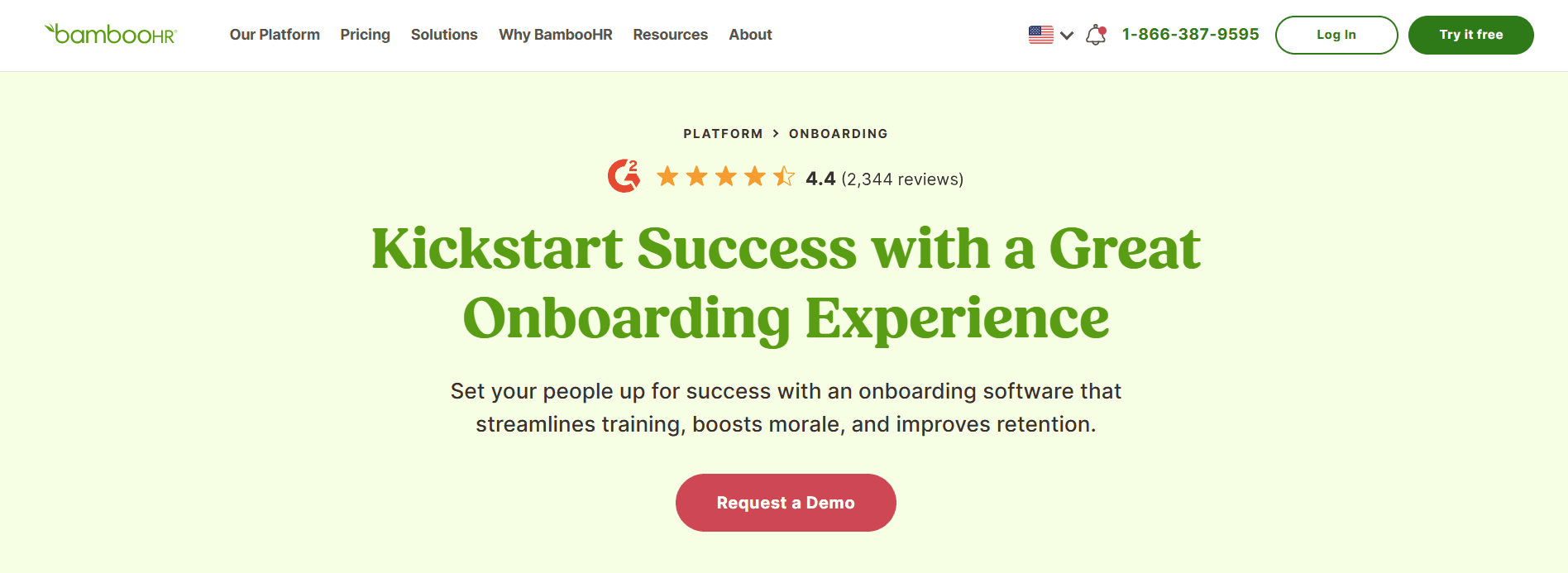
Source: BambooHR
Why do companies choose BambooHR?
Strong SMB to mid-market onboarding basics
A broad integration ecosystem and very strong user sentiment
A simpler, more approachable HR platform than heavyweight enterprise suites
“I love that BambooHR is easy to use,the org chart,hiring tab,reports, surveys (satisfaction and wellbeing) not forgetting the customer support who at any given time we experienced any challenge they resolved in less than 24hrs.” —BambooHR Capterra review
User-flagged challenges
TFN isn’t explicitly documented, and VEVO is manual
Payroll sync is export-based, not deeply native
IT provisioning and identity are integration-based
8. Bob
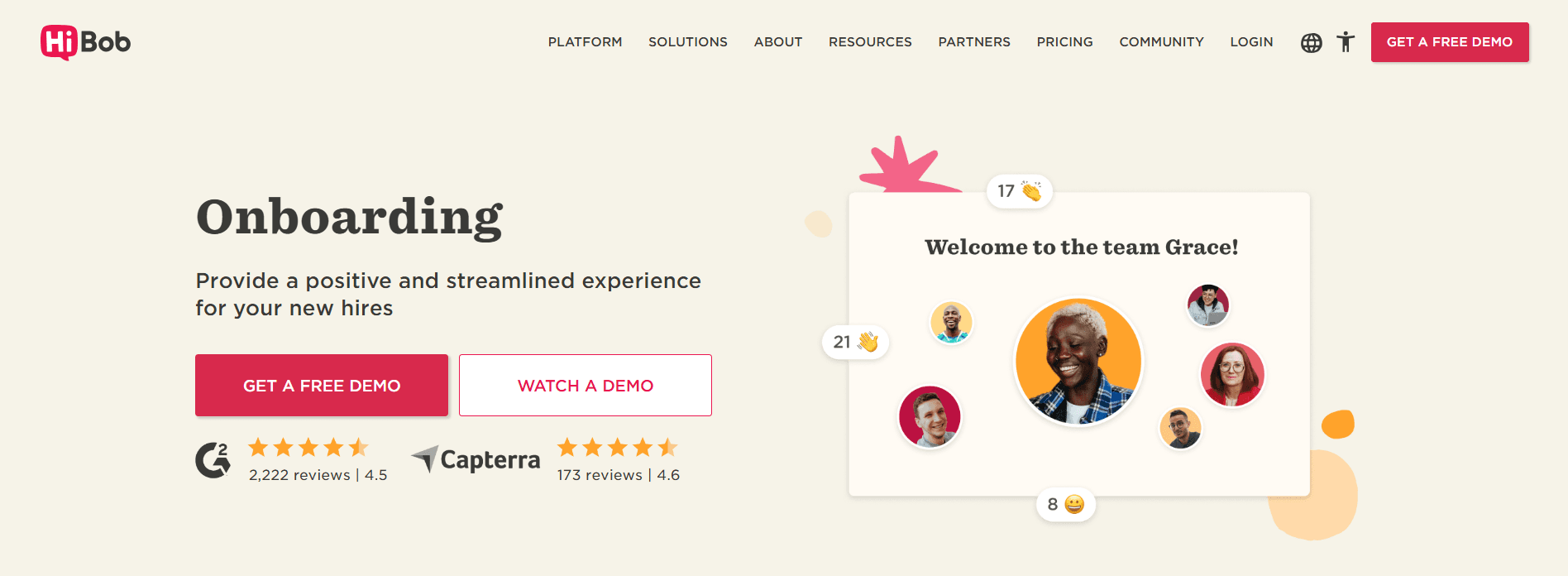
Bob is part of the larger HiBob suite (which includes talent management, payroll, finance, and more). Users can expect configurable employee document management workflows (not native), basic onboarding analytics, assistive AI, export-based payroll transfer, and native ATS, all wrapped up in a pleasing, user-friendly interface.
Bob offers plenty of standard-level (though dependable) HR onboarding features, even if it’s not quite as polished in compliance and automation as some larger competitors. For example, VEVO is manual.
Source: HiBob
Source: HiBob
Why do companies choose Bob?
A slick, modern onboarding experience for employees
Broad ecosystem/ATS connectivity for mid-market teams
Good balance of HR platform flexibility and employee experience
“Love it - the tools and the team that support it have been a great improvement on our last HRIS and they are always bringing out new and improved functionality.” —HiBob Capterra review
User-flagged challenges
It doesn’t offer much AU-specific compliance
Payroll transfer is export-based
IT provisioning and identity are integration-based
9. Personio
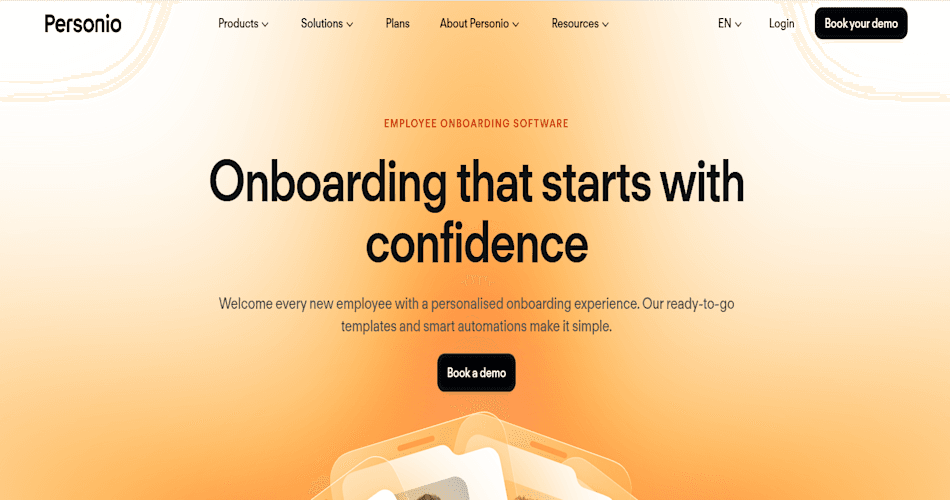
While technically a more lightweight HR onboarding platform aimed at mid-market companies, Personio does, in fact, offer a suite of onboarding, HR, and payroll solutions. The Personio onboarding software offers solid general onboarding capability, including a native portal, preboarding employee engagement, configurable document workflows, mobile UX, and e-signature. It integrates with familiar favourites like Xero and Slack, too.
As you’d expect with a slightly lower-rated onboarding platform, Personio relies on integrations for many core onboarding functions, including IT, asset, and identity provisioning, although it has a very strong sentiment score.
Source: Personio
Why do companies choose Personio?
Great mid-market onboarding basics, like workflows and e-signature
Broad ecosystem and native ATS connectivity
A clean, easy-to-use interface for fast adoption
“They also have a decent amount of workflows that you can build to automate your processes. Easy to set language you prefer the tool to work in. You can handle proper review cycles, a product still in development but may have a fairly promising future.” —Personio Capterra review
User-flagged challenges
AU compliance is generally limited
VEVO is manual
Payroll is export-based
10. Sage HR
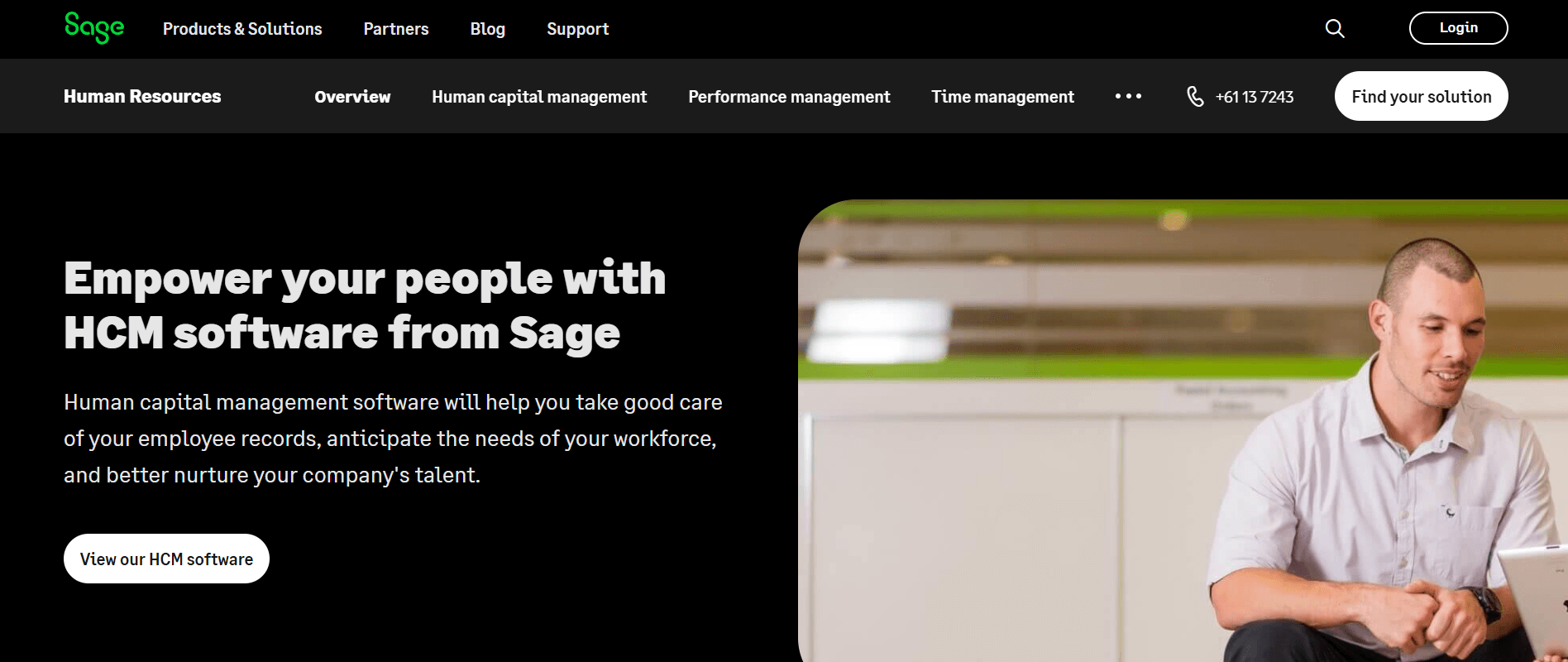
Sage HR deserves an honourable mention as an uncomplicated, lightweight HR and onboarding software that’s ideal for Australian SMBs. It provides all the basics you’d expect (mobile UX, e-signature, ATS connectivity) and optional features through a solid integration ecosystem, all without overcomplicating things for smaller teams. Its pricing is also highly transparent, which is a big plus for businesses with limited budgets.
Of course, Sage HR doesn’t have the same amount of advanced features that other, larger competitors have. TFN, for example, isn’t specified, payroll is via integration, and VEVO is manual.
Source: Sage HR
Why do companies choose Sage HR?
Good lightweight option for SMBs needing core onboarding
Broad enough ecosystem for smaller organisations
More moderate pricing transparency than some enterprise suites
“With Sage HR, we have best features and it makes HR processes easy. It is an affordable solution that is highly customizable to meet business needs.” —Sage HR Capterra review
User-flagged challenges
The document storage is basic
AU compliance is light
Identity setup is manual
Top 5 aspects to consider when choosing an onboarding platform
Every business has different employee onboarding needs, so doing your own research is important. Along with our best onboarding software breakdown above, also consider these factors:
1. AU-specific compliance coverage
A whole host of forms and compliance management obligations come with hiring, including everything from TFN (Tax File Number) reporting and super handling to Fair Work statements and visa checks. These processes are costly and time-consuming, especially if you’re completing them manually.
Native-level AU compliance is a massive plus. You can save yourself hours of data entry and let the software do it for you. At the very least, compliance integrations are a must.
2. Native vs bolted-on tools
One of the main reasons HR teams consider employee onboarding software in the first place is to save time and reduce data entry errors. However, while many demos look sleek, users often find that in reality, many features rely on exports and middleware, or even manual work (especially for payroll).
Where possible, you should always ask how much of the software is integration-based or manual and how much is truly native. This is especially important when onboarding spans HR, payroll, IT, and hiring systems.
3. Employee experience
Onboarding software isn’t just about making the process easier for the business. A great onboarding experience for employees can help to set the right tone from day one, as well as boost talent retention. Unfortunately, many onboarding software options fail to really excel here.
We recommend looking out for mobile-friendly task lists, preboarding access, e-signatures, and reminders, as well as a clean portal.
4. Automation and workflow flexibility
There’s a big difference between onboarding checklists and true onboarding process engines. You want to streamline onboarding and cut costs/time, so you might want to prioritise platforms that offer true workflow automation (or at the very least configurable workflows).
The best tools reduce admin by routing tasks automatically, triggering steps by worker type/location/business unit, and coordinating HR, manager, payroll, and IT actions. This is especially important if you’re dealing with multiple employment types across multiple regions in Australia.
5. Implementation effort
The largest HR onboarding platforms come packed with hundreds of features. This may look great on paper, but when it comes to actually implementing the software into your process, this kind of baggage can really slow things down.
Consider how user-friendly the interface is, as well as how easily the software integrates into your existing stack. It doesn’t matter how advanced the onboarding features are if no one can use them.
Simplify your employee onboarding process today
Some HR platforms offer a few, centralised onboarding features; others offer expansive, multi-layered suites. Few truly combine onboarding, payroll, IT, and finance into one cohesive employee onboarding experience. That’s why Rippling was my number-one choice.
Rippling sets the standard for innovative onboarding features while retaining strong onboarding basics across the board, not only for Australian businesses, but for organisations around the world.
See how Rippling can revolutionise your onboarding and request a demo today!
FAQs
What is the best employee onboarding software in Australia?
It depends on your unique needs, but Rippling is consistently rated the top employee onboarding software for Australian businesses. Rippling combines leading automation capability with native IT provisioning and a 650+ app integration ecosystem to streamline your entire onboarding process.
What are the top 5 HRIS systems in Australia?
There are many fantastic HRIS systems available in Australia right now. I conducted a lot of research into HR and onboarding capabilities and found that the top five platforms were Rippling, Employment Hero, ELMO HR, ADP Workforce Now, and Paycom, in that order. Rippling came first for its impressive workflow automation capabilities and extensive integration ecosystem.
What are the 5 Cs of employee onboarding?
The 5 Cs of employee onboarding explain the five key areas essential to successful hiring. They stand for compliance, clarification, confidence, connection, and culture. The five Cs encompass important factors that make for both a smoother HR team process and a more fulfilling employee onboarding experience.
Disclaimer
Rippling and its affiliates do not provide tax, accounting, or legal advice. This material has been prepared for informational purposes only, and is not intended to provide or be relied on for tax, accounting, or legal advice. You should consult your own tax, accounting and legal advisers before engaging in any related activities or transactions.
Rippling editorial policy: Rippling puts our customers (and prospective customers!) first. The Rippling team is committed to providing information supported by product data, expert insights, and real customer feedback to inform all of our content. All of our content is reviewed by product experts for accuracy and freshness.

Author

Alice Xerri
Content Writer
Alice Xerri is a content marketer and copywriter specialising in finance, payroll, HR, and tech. She writes for Rippling on topics across HR and payroll, with a focus on making topics easy to understand so the people who need them (whether that's an HR manager navigating a new compliance change or an employee trying to understand what it means for their pay) can actually use them. Alice is always thinking about the reader first, making sure every piece is clear, practical, and worth their time.
Hubs
See Rippling in action
Increase savings, automate busy work, and make better decisions by managing HR, IT and Finance in one place.